
First SkimFix it. Invent nothing.
Give Claude Code your resume and one job post. It marks every weak line and says why, then rewrites the resume so the job's must-haves land where a recruiter's first look lands. Every new line points back to the line it came from. When a fact is missing, it asks you instead of making it up.
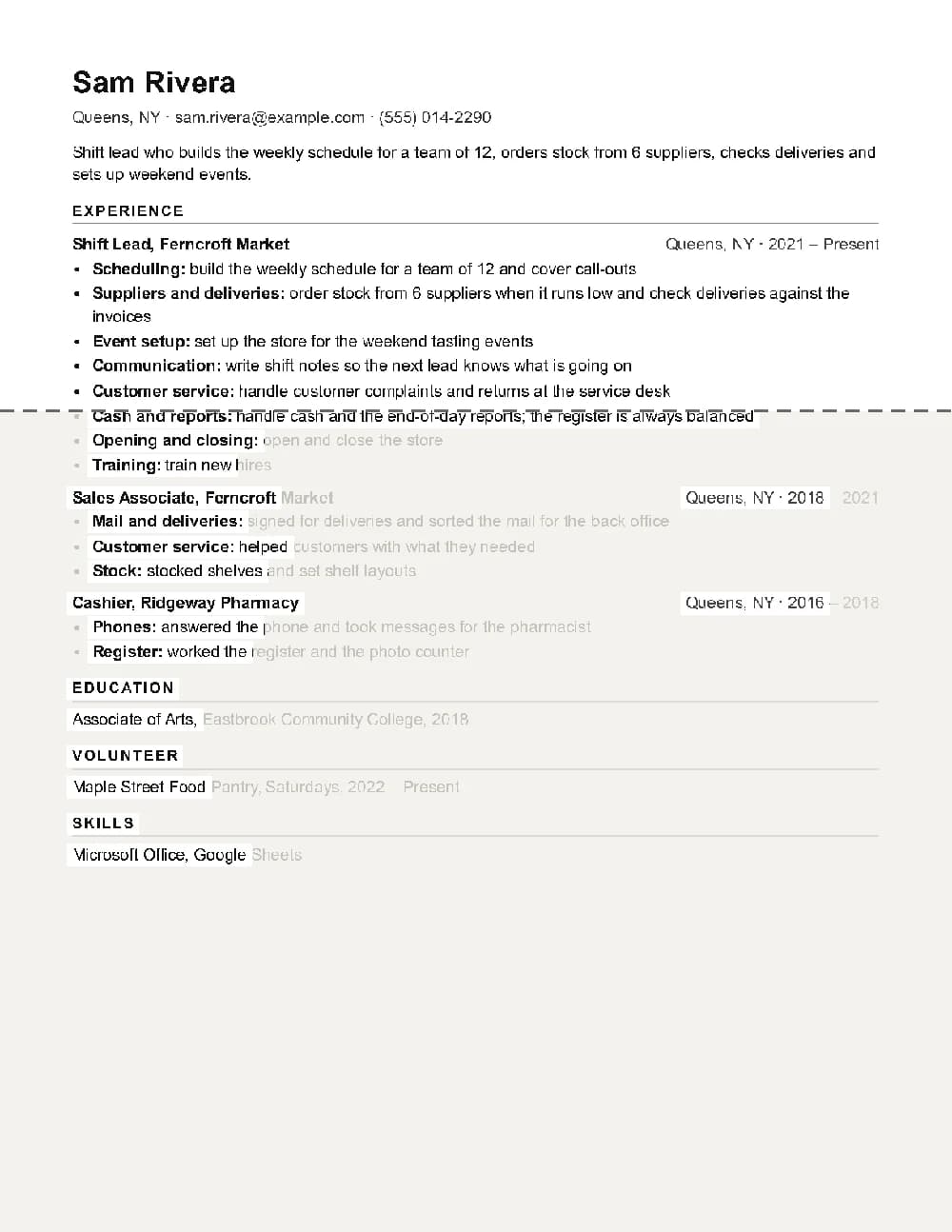
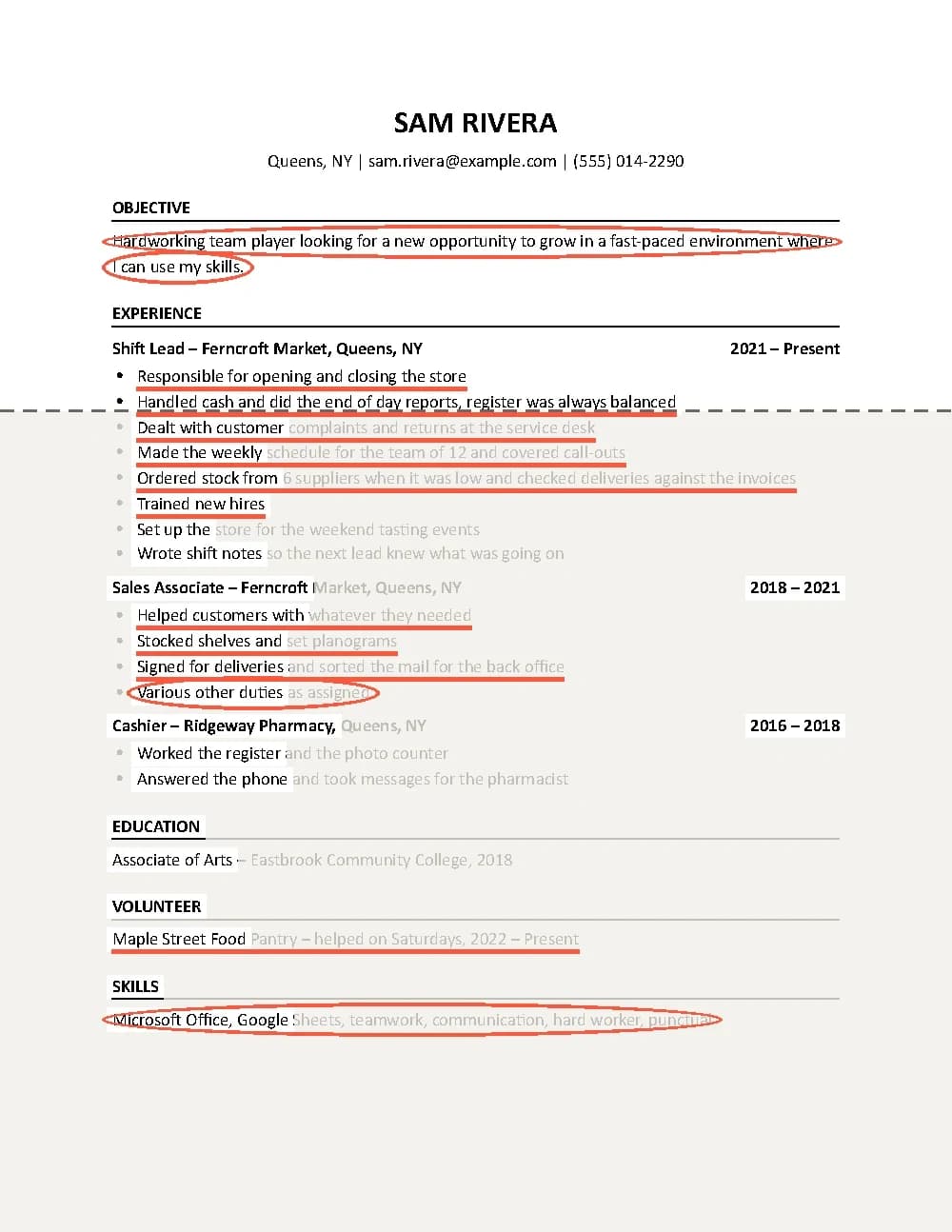 BeforeAfter
What plain AI did with the same resume
Same resume, same job post, asked the way most people ask: tailor it so it gets past the ATS. It came back with five things Sam never wrote, each one worded like the job post.
| Plain AI wrote | The job post says |
|---|---|
| “taking ownership of each issue until it is resolved” | “own issues through resolution” |
| “noticing what needs fixing before anyone asks” | “solving problems before being asked” |
| “Ready and excited to work in person in New York five days per week.” | “Able and excited to work from our New York office five days per week” |
| “balancing competing needs” | “anticipate competing needs” |
| “resetting the space afterward” | “rooms that need resetting” |
First Skim, on the same resume and post, wrote none of these. It asked 5 questions instead.
The test run
A fresh copy of the skill, a resume made up for the test (Sam Rivera, a retail shift lead) and a real, public office coordinator post from New York. Nobody answered its questions, so it kept every line to what the resume says.
It pulled 13 must-haves from the post, each with the post's own words, marked every weak line with a reason, rewrote the resume for that job and checked every number and name in the new version against the line it came from. Then it printed a one-page PDF, read the text back out of it, and ran the same resume again for a second job.
- Must-haves in the first look
- 3 → 6 of 13
- Lines marked
- 14
- Facts invented
- 0
- Questions asked
- 5
- PDF reads back
- 100%
- Both jobs, start to finish
- 3 min 48 s
What it does
One skill, a few scripts and the rules they follow. Claude does the reading and writing; the scripts count, check and print, so the numbers are the same every time you run them.
Counts the first look
Lists the job's must-haves from the post, then counts how many sit where a first look lands: the top third of page one and the first three words of every line. The same count runs before and after.
Marks every weak line
Duties instead of results, vague words, buried must-haves, old-job jargon, lines that say nothing. Each mark comes with a reason in a few words.
Rewrites for one job
Leads each line with the job's word for it and moves your strongest real experience into the top third. Your facts, the job's words.
Checks it invented nothing
Every new line names the line it came from. A script checks every number and name against that line and lists anything that doesn't match.
Asks instead of guessing
Up to five questions about things the job wants that your resume doesn't show. Your answers become sources; a no stays out.
A clean PDF and a report
One column, standard headings, real text, printed by Chrome and read back to prove it's clean. Plus a report page with the marks, the count and the source of every line.
How it works
Give it two things
Your resume as a PDF (or pasted text) and one job post, pasted or as a link.
See the marks
Every weak line marked with a reason, and the count of must-haves in the first look.
Answer a few questions
Up to five, only about things the job asks for. Skip any you can't answer with a yes.
Get the PDF
A one-page PDF for that job and a report you can click through. Another job? Run it again.
Who it's for
Career changers
Retail to office, teaching to training, service to sales: it finds your real experience in the new job's words.
People applying a lot
A tailored version per job in minutes, without the guesswork or the made-up lines.
Resume writers and coaches
Use it with your clients. Paid work is allowed.
First jobs
A thin resume gets the most from the questions: they surface what you did but never wrote down.
You need
Claude Code, Python 3.10 or newer with one free package (pdfplumber), and Google Chrome to print the PDF.
It runs on your computer. Your resume goes only where Claude Code already sends what you give it; the skill never pastes it into other sites.
Built on
PDF reading by pdfplumber (MIT), installed by you. The rules for marks and rewrites are our own.
The seven seconds: an eye-tracking study by The Ladders (2018) measured a recruiter's first look at about 7.4 seconds. Read the summary.
Get First Skim
Pay with USDT or USDC and download it right here, or message me on WhatsApp to pay another way.
Use it, and the resumes you make, for yourself and for clients, including paid work. Don't resell or share the skill's files.
Message me on WhatsAppPrice: 6 USD in stablecoins, about 5 EUR.
Questions
How do I get the file after paying?
Paste the transaction hash in the form above. Once the network confirms the payment, a download link appears on this page.
Will it get me past the ATS?
No tool can promise that, and this one doesn't. The popular "75% of resumes are rejected by a robot" number has no study behind it. What it does: puts the job's must-haves where a first look lands, and proves every line is yours.
What if my resume is a Word file or two columns?
Save it as PDF first. Two-column layouts may read out of order; the rewrite is always one column, which every hiring system reads.
I lost my download link.
Message me on WhatsApp with the transaction hash and I'll send a new one.